Seventeen Secrets

Working with the Hat & Rabbit Club, I edited a 60-page booklet with contributions from some of my favourite magicians. We talked everyone who spoke or presented for the club this season to contribute an item and have produced Seventeen Secrets.  It includes contributions from James Biss, Matt DiSero, Richard Forget, Murray Hatfield, Will Houstoun, Joshua Jay, Michael Weber, Tyler Wilson, and a piece from my show. The booklet was produced in a limited edition of one hundred numbered copies.

The booklet is $20, available from the Ring 17 online store.

Cover

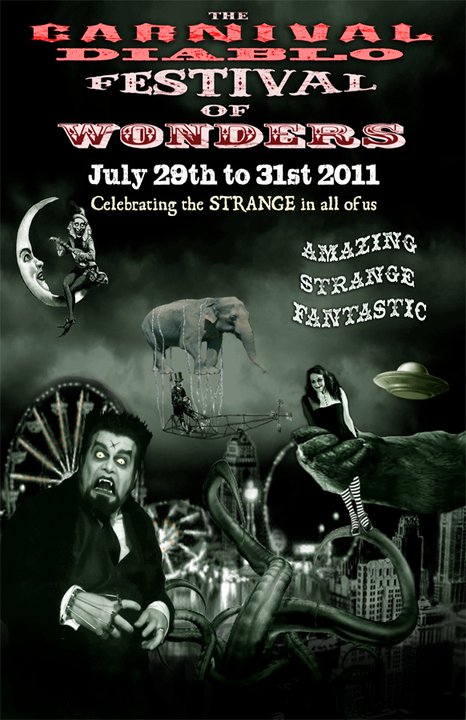
Carnival Diablo Festival of Wonders

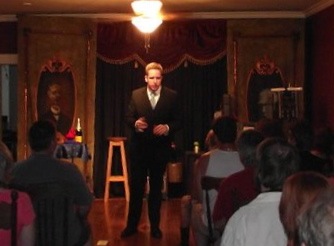
This weekend I had the pleasure of performing at the Carnival Diablo Festival of wonders. The owner of the carnival, a friend of mine named Scott McClelland has created several vivid characters for extravagant sides that appeal to different sides of magic, including side show, bizarre magick, spiritualism and even carnival hucksterism. As part of the festival which incorporated several of his shows, a side show and a number of other acts, I presented a series of half-hour performances featuring some of the oldest magic in my repertoire. Oldest in terms of its age, at least.

Diablo1

In addition to being able to perform on the beautiful Paranormal Show set, I got to spend two days at the gorgeous waterfront property in Carleton Place where the festival was being held.

Carnival Diablo

The Desert Island

What use would a magician have on a desert island? Someone posted a detailed thought experiment on a magic discussion forum, probably hoping to start a heated argument then sit back and watch the ad hominem attacks start flying.

The scenario was a bit more nuanced. Assume you were to be stranded on a desert island and could choose ten people to join you. These people would share the responsibility for survival. His contention was that a magician wouldn't make that list.

His conclusion: magicians didn't serve a useful purpose in the world.

While I agree that he should take people that aren't magicians (and therefore not me) with him to deserted islands, I think the conclusion is backwards. Because most of us don't live on desert islands and have no plans to wind up there. In fact magicians can exist and earn a living precisely because we are not struggling for survival. So the existence of magicians becomes, by contrast to the original conclusion, a celebration of our success as a species.

Reality Based Magic

What's in a title? A great deal of what I read about magic is disconnected from reality in some way, and not in the good way that magic is supposed to be separate from reality. It seems that most don't feel the need to ground what they believe firmly in the real world. Instead, they reason a priori. However, that kind of thinking is only valid if the starting premises are valid. And most often those premises are gut feelings and anecdotal observations which are cantilevered out well past the point of reliability.

My favourite example is the statement;

"People don't like card tricks."

Originally, I bought into this theory and made a conscious effort to start every performance with something which was not a card trick. The second piece was then often a card trick. Then I observed something which confused me tremendously: when the first trick was done and the cards came out of my pocket, someone would exclaim with excitement,

"Oooh, card tricks!"

It took a while for me to figure out why this was happening. It didn't happen often, but it happened far too often for those enthusiastic (and obviously very intelligent) people to be considered true outliers.

Now I have a theory. The "people hate card tricks" hypothesis seems to be based on a misapplication of Bayesian reasoning. The problem with anything (including card tricks) is something known as Sturgeon's Law which states that:

Ninety percent of everything is crap.

Unfortunately, it appears that in the world today, nearly ninety percent of magic is card tricks, which is an invitation to Bayesian disaster. The dislike should have been attributed to the general ambient crappiness, and not to the actual card tricks.

What people really want to say is, "We dislike bad magic." However in terms of frequency, most of that boring magic will be card tricks, and so the cards wind up with most of the blame.

What can be done?

I'm reminded of the words of Richard Feynman:

If it doesn't agree with experiment, it's wrong. That's all there is to it. It doesn't matter how beautiful your theory is or how smart you are. If it doesn't agree with experiment, then it's wrong.

So we should try to challenge our ideas more often and always be on the lookout for deeper understanding. We should always be striving to create reality based magic.

I confess, I was also inspired by an aid to the Bush administration who referred to the scientific and secular lobby as "the reality based community".