Chris Westfall and the Porcelain Princess

My specialty has always been "magic for grownups" but I'm often asked about doing things for younger kids and for families which usually leaves me recommending my friends who do a much better job with that sort of thing.
https---cdn.evbuc.com-images-39609770-135589975101-1-original.jpg

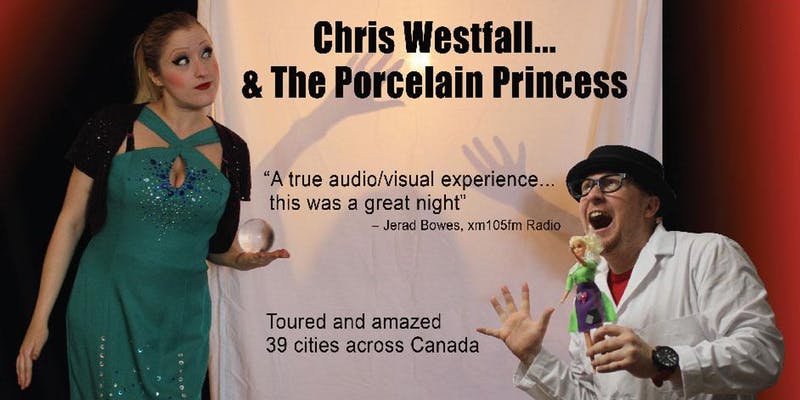
Coming up in a few weeks at the Paper Mill Theatre in Toronto, there is a wonderful family show for kids and families. A good friend Chris Westfall has teamed up with circus artist Bella to create Chris Westfall and the Porcelain Princess. The show toured around Ontario just over a year ago and received some very nice reviews. If you're looking for an amazing and fun (and amazingly fun) family activity, it's in town for just two nights in July.
 

chris_child.rope.jpg

Chris Westfall & The Porcelain Princess
Thursday & Friday, July 19 & 20 @ 6:30 PM
The Paper Mill Theatre - 67 Pottery Road

 
“Chris Westfall... & The Porcelain Princess is a true magic theatre experience. It brings the arts of illusion, circus, improv and comedy together in one amzing show perfect for the whole family. It will baffle and amaze. Keep you on the edge of your seats at the top of your imagination. Watch Chris Westfall make people appear, diappear and float while laughing the entrie way through.”

Tickets start at $29 and you can use the promotional code secrets to get an extra discount when you reserve online. 

And the Award goes to....

The Allan Slaight Awards recognize outstanding achievement in the pursuit of the impossible. The Slaight Family Foundation established the awards in 2015 and has pledged to give $50,000 a year, over five years, to celebrate exceptional work in five distinct categories. Each recipient receives not only a cash prize, but also a specially engraved iPad to commemorate the achievement.
— Magicana.com

The Allan Slaight Awards are distributed every year, celebrating extraordinary talent and accomplishments in the world of magic. This year, the recipients are being announced online, spread out over a week. The first award was announced this morning is the Canadian Rising Star:

The recipient is absolutely one of my favourite performers on the planet, Nick Wallace. His 2016 show Séance remains one of the finest live productions I've ever seen. When I was hosting Magic Tonight, Nick was a welcome guest many times. I once described him thusly:

He may pretend to look all sweet and inocent, but I am starting to suspect that he may, in fact, be the devil. Pure evil wrapped in Mr. Rogers’ sweater.
— Me, ca. 2015

Congratulations, Nick, on this well-deserved award. Stay spooky. 

Magic with Physics

The extremely popular YouTube channel Numberphile (popular among nerds at least), they often tread into magical territory. Here one of their frequent guests Tadashi, explains an amusing technique for levitating a pingpong ball (and the physics behind it.)

When I was the host of Magic Tonight in Toronto, the comedy magician extraordinaire Wes Zaharuk used to use this as a bit in his show to great effect: 

Wes Zaharuk

Wes Zaharuk

Space is Big

As the saying goes:

Space is big. Really big. You just won’t believe how vastly, hugely, mind-bogglingly big it is. I mean, you may think it’s a long way down the road to the chemist, but that’s just peanuts to space.
— Douglas Adams - The Hitchhiker's Guide To the Galaxy

[A note for North American readers, the "chemist" is a pharmacy.]

This clip from BigThink by NASA Scientist Michelle Thaller tries to put that bigness in perspective:

These numbers are hard to imagine. VERY hard to imagine. That's one of the reasons I'm such a strong proponent of math education for everyone of all ages (beyond my own personal bias as a math major shining through.) The only way to learn to cope with these kinds of numbers is through training. Otherwise you'll be caught in the paradigm of JBS Haldane:

My own suspicion is that the universe is not only queerer than we suppose, but queerer than we can suppose.
— JBS Haldane

Math becomes the key that allows you to do all that hitherto impossible supposing. Or, if you'd rather think of the world in terms of awe and wonder, it gives you access to entirely different domains in which to be astonished.

Difficult to believe

Somehow an article snuck its way past the editor and onto the pages of the New York Times praising the benefits of (how I wish I were making this up) ASTROLOGY. It's an opinion piece by Krista Burton from the last few days and it's difficult to make sense of. 

I'll start at the end and work my way back. The article ends with the strange quasi-disclaimer: 

Now, I’m not stupid. I may be a woo-woo, crystal-worshiping homosexual, but I know that a polished red rock is not going to heal my tailbone. It’s not going to bring my mom back either. It may not do a thing. But none of us know anything about anything, really. So why not be open to the possibility of hope?

[Note, the author self-identifies as homosexual, so the term isn't being used here as a pejorative. JA]

First to the subject about knowing "anything about anything": Even though in 2018 it should go without saying, it apparently needs saying that all of the subjects which this article centres around — astrology, crystal healing, tarot cards — is nonsense. It is an entirely uncontroversial scientific fact. Just to make the point, smashing a walnut with a sledgehammer, here is an excerpt from a lecture given by Professor Richard Feynman (who happened to win the Nobel Prize for work which is still widely used today) gave in 1964 explaining the state of scientific knowledge. 

That statement is naturalism in a nutshell and perhaps one of the most profound discoveries in human history. This clip is 50 years old and is even more true now than it was then. 

We're allowed to call nonsense nonsense. But that's what makes the article troubling. It seems to be a call to take these ideas seriously, but rather a plea to be politely ignored so they can believe nonsense in private. 

It's an interesting moral dilemma. At what point does the value of being polite and courteous trump the value of being factually accurate? After all, if we're really supposed to have liberty, doesn't that include the liberty to believe things that aren't true and be left alone? And the answer would be a solid maybe but for the fact that she's published in the New York Times and therefore every silly thing she says is fair game.

Deep down, this is an article written in defence of The Placebo Effect — epistemological hedonism — if it makes you feel better, believe it. But this is something that needs to be fought, fake news aside. The reason she is in this situation is because of health concerns:

...after seeing a doctor and two chiropractors, I was referred to a massage therapist/energy worker who worked out of a chiropractor’s office.

So it's not reasonable to make the argument that these beliefs aren't causing harm. Because even if they themselves have no effect, she's wasting time that would otherwise be spent getting actual medical care. 

So perhaps we could (politely) try and put a stop to this.